Brand & Marketing Kit · 2026

Ilapesi
Charcoal & Briquettes
Ilapesi · isiXhosa for the Resin bush · Euryops sp.
Small-batch charcoal, hand-packed for the fire.
Assets
Logo, a transparent logo for the tote, canvas and screen, bag mockup, shelf tag, tote, business card, works layout, the cost sheet and photography, as PNG files. Allow multiple downloads if your browser asks.
01 — Positioning
A small fire brand, deliberately small
Ilapesi is the isiXhosa name for the resin bush (Euryops) that takes over the mountain grassland above Lady Frere in the Eastern Cape — cleared from grazing land, cut for the fire. The brand borrows its name from that scrub: charcoal and briquettes sold by the bag, packed by hand, with an identity kept plain. Black stock, one ember accent, honest copy.
Small batch
Packed a few bags at a time, stamped with the batch number, never warehoused.
Sorted by hand
Lumpwood and pressed briquettes picked over before they go into a bag.
Sold close
A short list of stockists and the stall — one bag, one fire, no pallets.
02 — The mark
The bush the fire is named for
The mark is the ilapesi itself — a single resin-bush sprig (Euryops) cut as a woodcut: one woody stem of fine resinous leaves under a single daisy head. It reads as mountain scrub, not as flame, and it works solid black on paper, reversed out of the bag, and as a stamp on the bag seam.
Ilapesi
- isiXhosa
- Ilapesi — the name the brand is built on.
- English
- Resin bush, also called golden daisy bush.
- Botanical
- Euryops sp., daisy family (Asteraceae).
- Where it grows
- Mountain grassland above Lady Frere, Eastern Cape. Cleared where it takes over grazing, cut for the fire.
- Clear space
- Keep a margin equal to the height of the flower head on all four sides.
- Minimum size
- 18 mm wide on print, 20 px on screen. Below that, use the wordmark alone.
- Never
- Stretch it, add a drop shadow, recolour it, or set it loose on photography without a charcoal panel behind it.
03 — Colour
Charcoal, bone, ember — and the bush itself
Three working colours do the selling: charcoal ink on kraft or bone stock, with ember once per piece. Resin and Daisy are lifted straight off the plant the brand is named for — the leaf and the flower head — and belong in illustration and screen work, not on the bag.
Charcoal
#0E0D0C
Bags, signage ground, wordmark on light stock
Ember
#C1492A
One accent only: seals, batch stamps, the first line
Kraft
#BE9A6A
Bag paper, tape, card stock
Ash
#8C857B
Secondary type, rules, dividers
Bone
#F3EFE7
Label ground, reversed type, paper
Resin
#5C6B4A
Leaf green from the bush — illustration and digital marketing only
Daisy
#C9A227
Flower-head yellow — illustration and campaign accents, never on the bag
04 — Typography
Two voices: plain speech, wide air
A wide-tracked sans for the name, a serif for anything spoken aloud. Nothing decorative, no second display face.
Wordmark
Uppercase · 0.26em tracking · medium weight · never italic, never outlined
Headline
Serif · regular · tight tracking — prices, pack sizes, stall cards
Body & captions
Sans · light · sentence case for reading, uppercase with wide tracking for labels
05 — The bag
Kraft outside, charcoal panel inside the fold
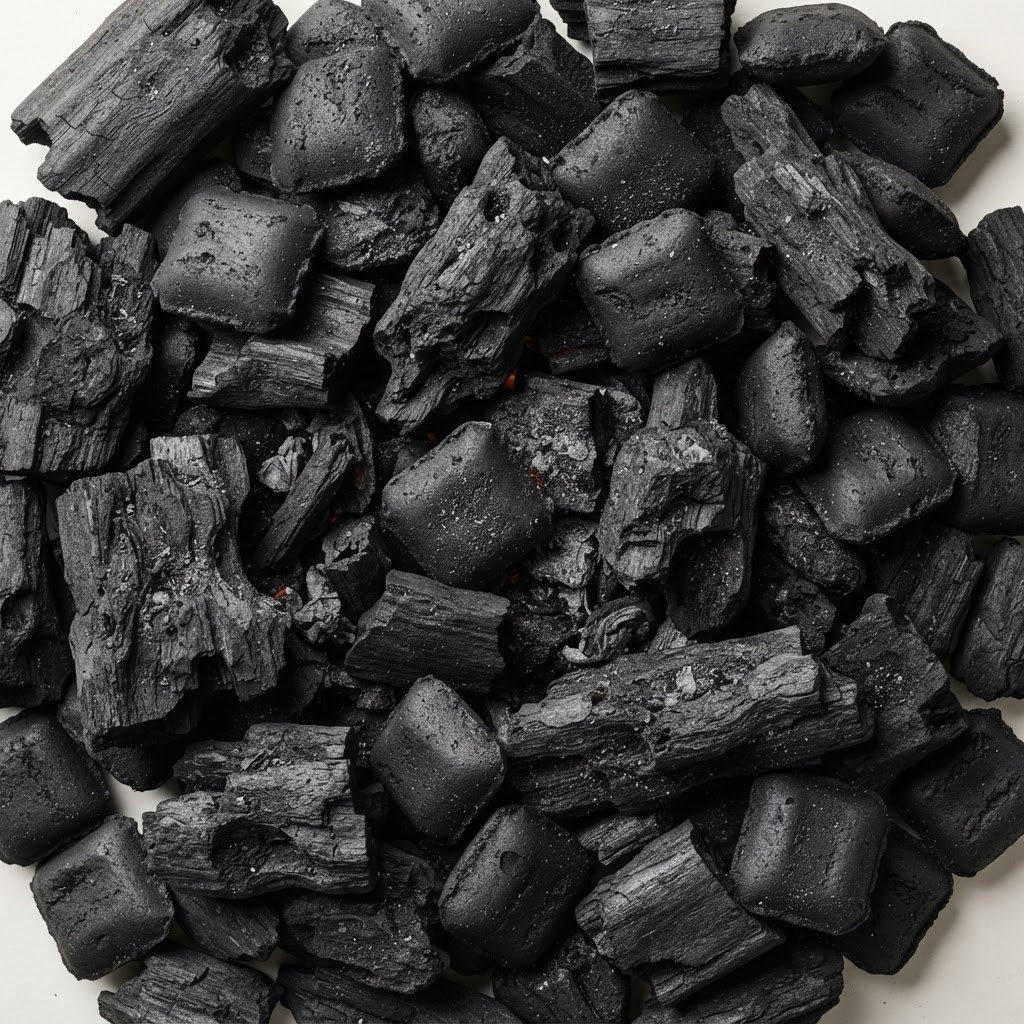
A plain kraft bag with one black printed panel on the front. The ilapesi sprig sits at the top, the name in wide caps, the weight in the serif. A round ember sticker carries the batch number.

Ilapesi
Hardwood charcoal
10 kg
Burn outdoors or in a well-ventilated area
No. 014
Hardwood charcoal
Lumpwood, graded by hand
5 kg
Hardwood charcoal
The braai bag, packed to the fold
10 kg
Charcoal briquettes
Pressed, uniform pieces
4 kg
- Stock
- Natural kraft, 90 gsm, flat-bottomed, rolled top.
- One colour, charcoal, on the front panel only. Nothing on the gussets.
- Seal
- Ember circle, 50 mm, batch number written in after packing.
- Before print
- Check the safety and disposal wording against current local requirements.
06 — Stall card
The card that does the selling
A6, charcoal stock, propped on the table. Three lines, prices filled in by hand or overprinted — it is designed to be reprinted the moment a price changes.
By the bag
Ilapesi
- 5 kgR ——
- 10 kgR ——
- 4 kgR ——
Cash on the day · Bring your own bag if you have one
Keep a stack of these printed and blank. Fill the prices in with a marker, overprint them, or leave the dotted line and write the day’s price at the stall.
- — A6, 105 × 148 mm, charcoal 300 gsm, matte.
- — Print the reverse side with the batch number and stockist list.
- — Prices stay blank in the kit; fill yours in before printing.
08 — Shelf tag
The tag that hangs off the bag
Kraft, punched and strung. It carries the weight and the batch number and nothing else — whoever sells the bag writes the price on the back.
Ilapesi
Charcoal & Briquettes
10 kg
Batch No. 014
Tie one tag to every bag before it leaves the yard. The front says what it is and how heavy it is, the back stays blank so a stockist can write its own price.
- — 45 × 95 mm, 400 gsm kraft, single 8 mm punch.
- — Batch number and ember dot stamped by hand, never printed clean.
- — One hole, one string: twine or waxed cotton, the same colour as the kraft.
09 — Tote bag
The bag that comes back
Natural canvas, one colour of ink, the ilapesi sprig over the name in the same letterspacing as the bag. It is the one piece of the brand that walks home with the customer and returns to the stall.
Ilapesi
Charcoal & Briquettes
charcoal by the bag
Print it the day you run out of kraft bags. One screen, one pass, no second colour anywhere except the single ember rule under the name.
- — 38 × 42 cm, 10 oz unbleached cotton canvas, long handles.
- — Sprig mark prints solid, 34 mm high, centred above the name.
- — Print block sits 120 mm from the top, 190 mm wide, centred.
- — Ember rule is the only accent; leave the reverse side blank.
07 — Business card
One card, plain paper
85 × 55 mm, printed both sides. The front is quiet — mark, name, nothing else. The back carries the things a buyer actually needs: a name, a number, and where to find the bags.
Ilapesi
Charcoal & Briquettes
Your name
Packer & seller
+27 —— ——— ————
your email address
Stockists on request
Charcoal by the bag
The name, number and email on the back are placeholders — replace them before printing. Allow 3 mm bleed and keep type 4 mm inside the trim.
10 — Works layout
A yard that runs one way
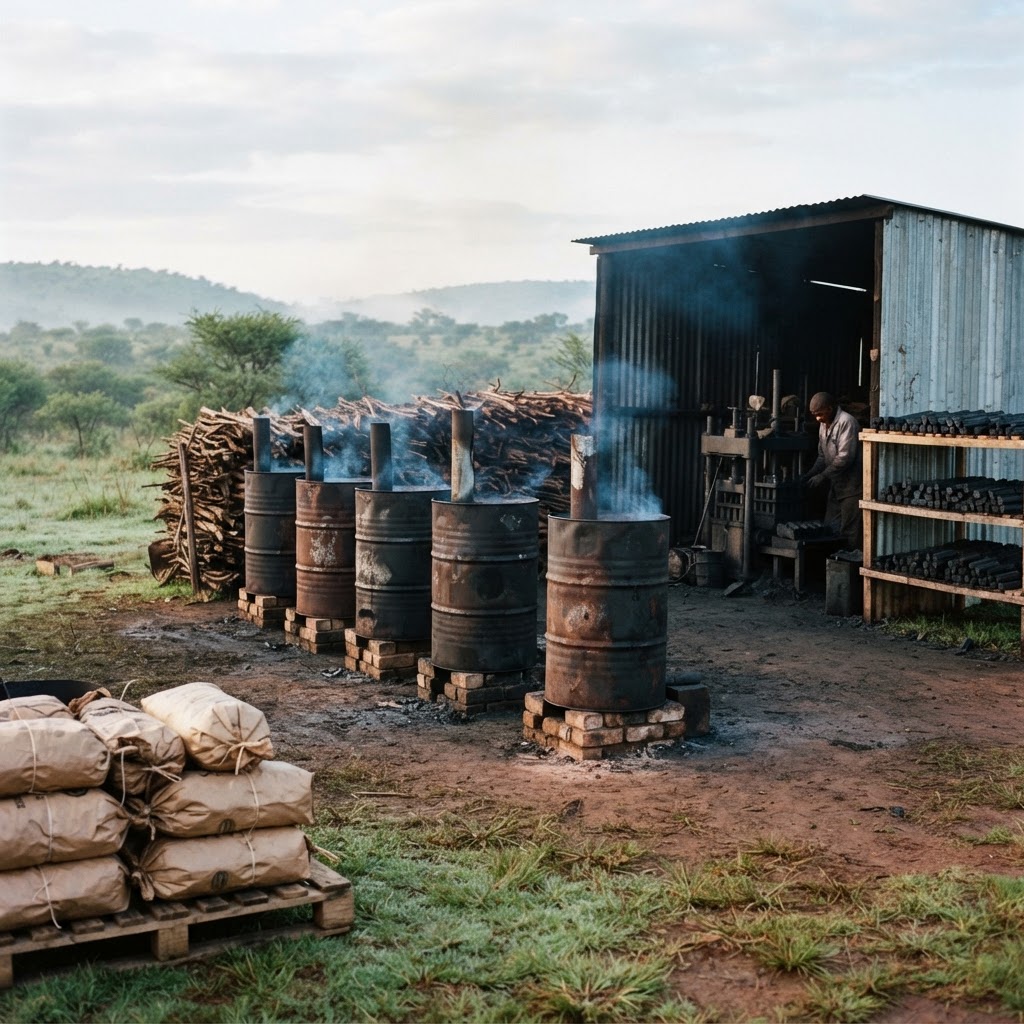
Feedstock in at the intake, fire in the middle of the yard, finished bags out at the store. Nothing loaded ever crosses back past the retorts. The barrels sit outside on brick plinths; the press, the racks and the mould bench sit under roof.
01
Intake & sorting yard
Alien wattle and hardwood offcuts stacked and air-dried 6–8 weeks, cut to 900 mm. Wet stock kept apart from dry.
Outside · 6 × 8 m
02
Retort bank
Six 200 L drum retorts on brick plinths, 2 m apart, lids clamped, flue to 4 m. No barrels inside the shed.
6 barrels on plinths
03
Quench & sieve
Charcoal tipped into the quench tank, ash knocked off, fines sieved out and bagged for the briquette line.
3 × 3 m
04
Milling & binder
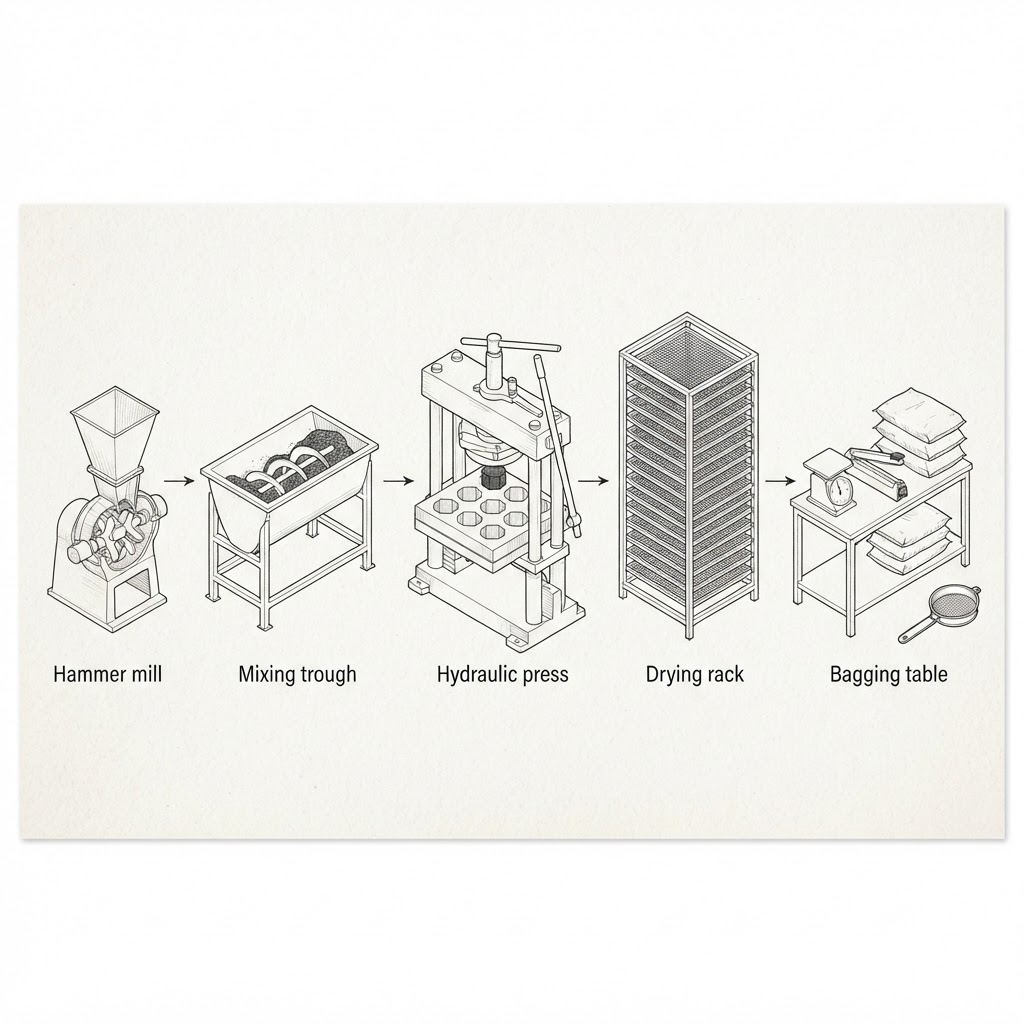
Hammer mill down to 3 mm, binder mixed in the trough at 8 parts char to 1 part binder.
2 × 3 m
05
Press bay
One press with two interchangeable die plates — briquettes on one, kindling rounds on the other.
2 × 3 m
06
Drying racks
Two racks of 24 trays, 5–7 days ambient, or 2 days under forced air. Never stacked wet.
2 × 3 m, ventilated
07
Weighing & bagging
Bagging table, platform scale, heat sealer, batch stamp and the safety wording panel.
2 × 3 m
08
Finished goods store
Pallets off the floor, dry, away from the retorts. First in, first out. Stockists collect from here.
2 × 3 m, raised
09
Mouldmaker & repair bench
Vice, drill press, welder and a stock of drum lids and die plates — every mould in the works is made or repaired at this bench.
2 × 3 m
10
Access & dispatch
Vehicles enter at the intake end and leave from the store apron, so loaded bags never cross the fire line.
One-way vehicle loop
Equipment & materials
- 200 L steel drum retort, 1.5 mm, clamp lid6
- Brick plinth, two courses, 400 × 400 mm6
- Flue pipe, 100 mm × 4 m6
- Quench tank, 500 L1
- Hammer mill, 3 kW1
- Binder trough and paddle1
- Briquette press, 20 t hydraulic1
- Die plates, interchangeable3
- Drying rack, 24 trays2
- Platform scale, 150 kg1
- Heat sealer and bagging table1
- Sieve, 5 mm mesh2
- Sand bucket and extinguisher3
- Yield per retort
- 18–22 kg charcoal
- Burns per week
- 2 per retort, 12 total
- Briquette line
- ~1 200 units per pressing day
- Fines into binder
- All material under 5 mm
Plant drawings & reference works
illustrative · not for construction
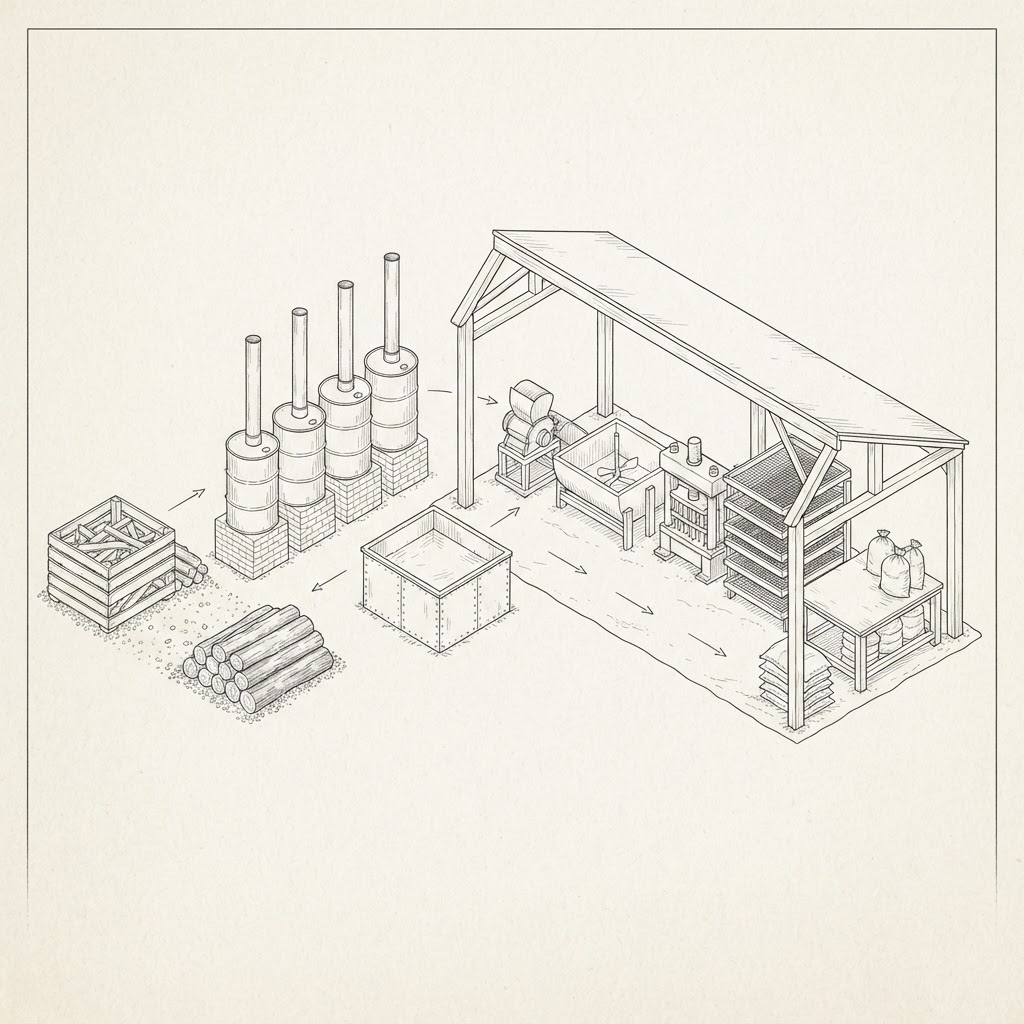
The whole works in one view
Feedstock yard, the bank of six retorts, quench tank, then the mill, trough, press, drying racks and bagging table under roof. One direction of travel — nothing loaded crosses back past the fire line.
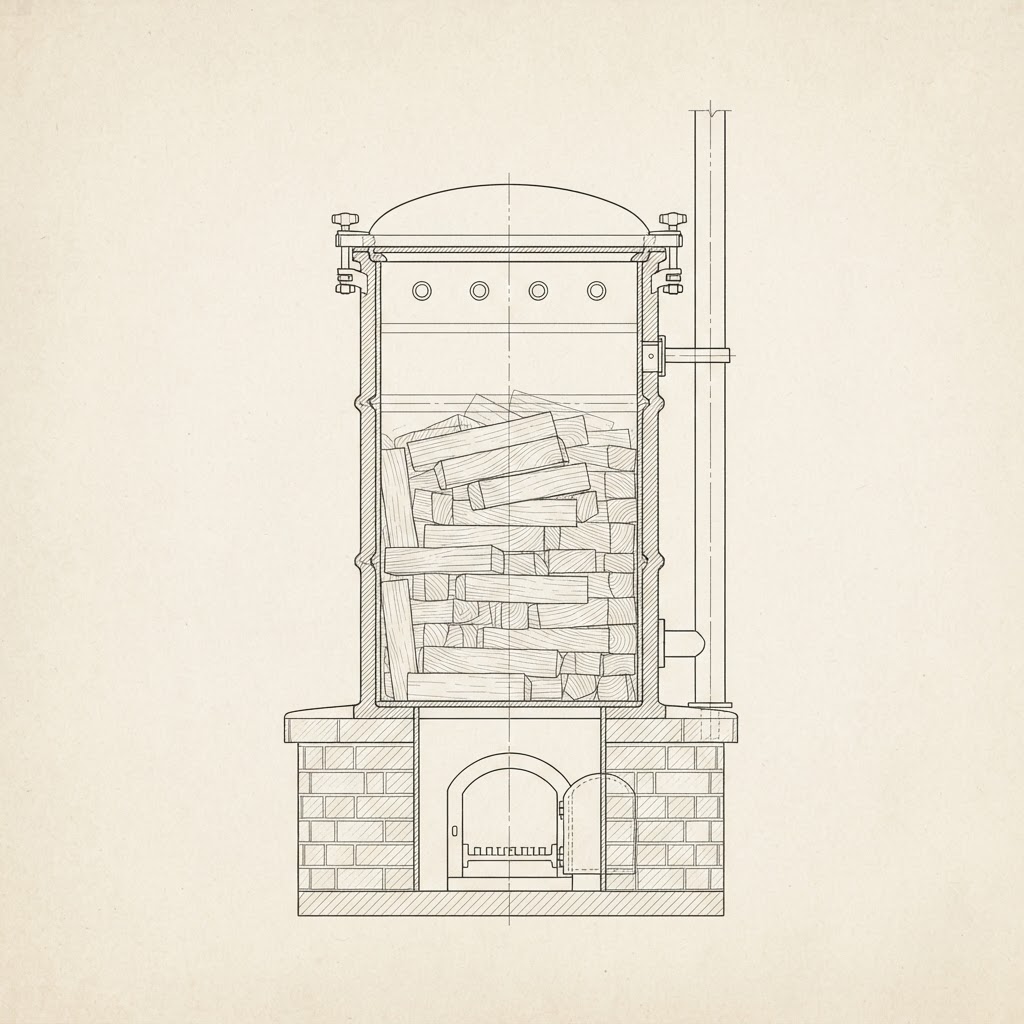
Drum retort on its plinth
Cut-away of one 200 L retort: clamped lid with gasket, four vent ports below the rim, charge stacked inside, fire box beneath the brick plinth and a flue carried above head height.
Mill through to bagging
Hammer mill, binder trough, the press with its nine-cavity die, two racks of twenty-four trays, then the scale, heat sealer and bagging table.
A morning at the yard
Six retorts smoking on their plinths, feedstock behind, bags palleted in front of the shed — the picture to hold in mind when siting the real thing.
A burn, in motion
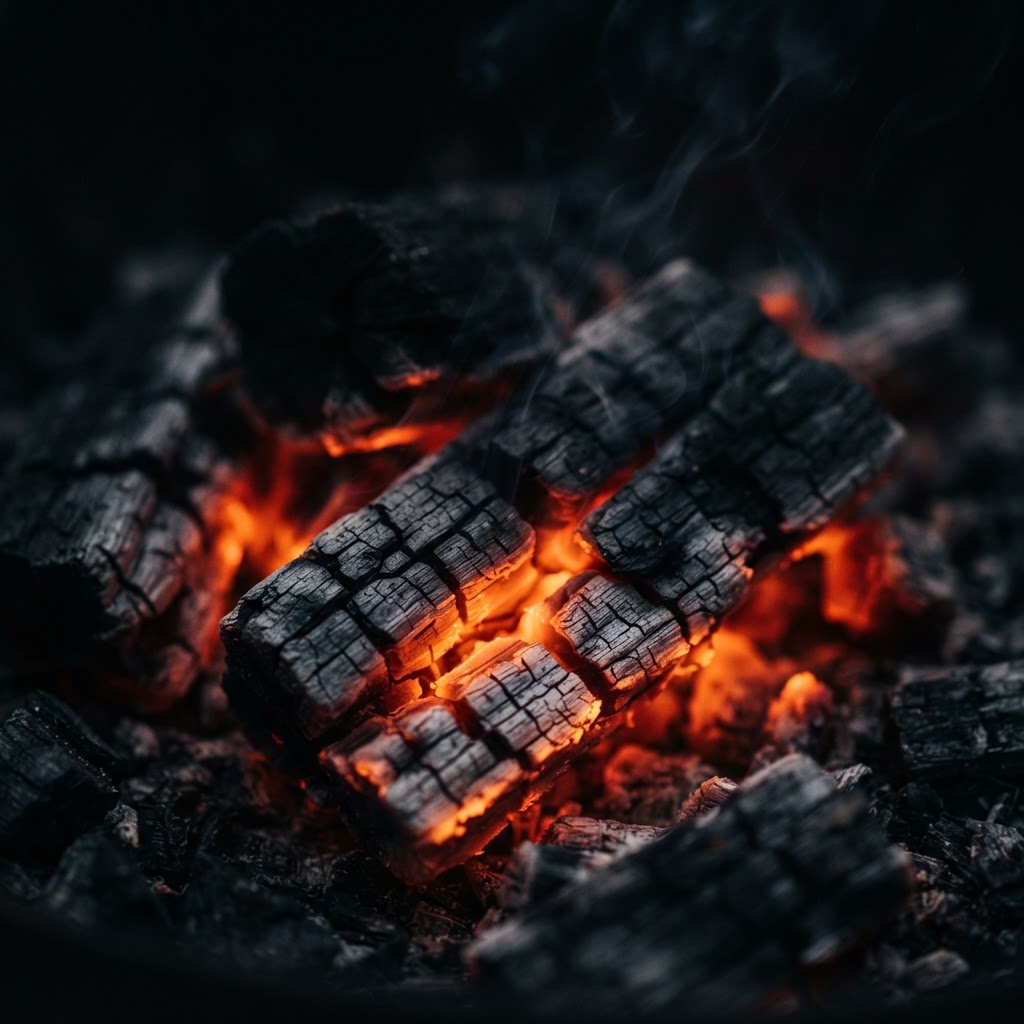
One retort opened, the charge checked, the lid clamped home. Watch the flue smoke thin as the load finishes — that is the moment to close the vents and move the drum to the quench.
How other small works are set out
Photographs of working kilns and charcoal yards, kept as reference only. Look at three things: how the kilns are banked in a row, how wet stock is kept apart from dry, and how close the bags sit to the fire.

Barrel kiln, branch and twig wood
A drum kiln worked by hand — the closest thing to our retort bank.
Source · Wikimedia Commons
A charcoal works, yard scale
Small works where burning, cooling and bagging share one yard.
Source · Wikimedia Commons
Carbonising at yard scale
What a one-to-two-burn-a-week operation looks like in the open.
Source · Wikimedia CommonsSheets 01–03 are drawn from the works layout above so the team can see one process, not ten separate rooms. They are illustrative and not to scale. Sheet 04 is an impression of the finished yard. Before the first burn, have a fabricator and the local fire authority check clearances, flue heights and the firebreak.
Retort drum
200 L open-head drum, 1.5 mm mild steel, unpainted inside. Four 25 mm vent ports 100 mm below the rim, clamp lid with a 4 mm gasket, no holes in the base.
Briquette die
6 mm plate, 380 × 380 mm outside, nine 40 mm hexagonal cavities, bolted to the press platen. A second plate of twelve 30 mm rounds is cut for kindling.
Punch and ejector
10 mm steel rods, hardened tips, 5 mm clearance in the cavity so the briquette drops clean without cracking.
Mix and pressure
8 parts char to 1 part binder by volume, 25–30% water, pressed at about 20 t and dried until it rings when tapped.
This is a proposed layout, not an engineering drawing. Settle the flue heights, firebreaks, clearances and zoning with your local fire authority and municipality before the first burn, and keep the retorts well clear of the bagging and store area.
11 — Cost to build
What the works costs to stand up
Everything below is priced for a Lady Frere site in 2026, excluding VAT: the shed, the retort bank, the press and its moulds, the tools, the permits and the labour to install it all. The contingency line is not padding — it is the drum lids you will cut wrong.
Setup, all in
R670 000
Plant, shed, tools, permits and installation, including 10% contingency.
Rated output
800 bags
1 000 kg lump and 7 000 kg of briquettes a month, in 10 kg bags.
Cost per bag
R151
Full cost including the plant written off over five years — see the breakdown below.
Structure & site
- Steel-frame shed, 150 m², roofed, part-cladR165 000
- Concrete hardstanding and bagging slab, 45 m²R38 000
- Water tank, gutters and standR12 000
- Electrical connection, DB board, lightingR34 500
SubtotalR249 500
Carbonising plant
- 6 × 200 L retort drums, seam-welded, with clamp lidsR8 700
- 6 brick plinths, two coursesR5 100
- 6 flue pipes, 100 mm × 4 mR3 720
- Quench tank, 500 LR6 800
- Sieve frames and 5 mm meshR2 400
SubtotalR26 720
Briquetting line
- Hammer mill, 3 kWR24 500
- Binder trough with paddleR4 200
- Briquette press, 20 t hydraulicR62 000
- 3 die plates — 2 briquette, 1 kindling (mouldmaker)R14 400
- 2 drying racks, 24 trays eachR15 000
SubtotalR120 100
Packing & handling
- Platform scale, 150 kgR3 200
- Bagging tableR4 500
- Heat sealerR2 800
- 1.5 t trailer for deliveriesR42 000
SubtotalR52 500
Mouldmaker's bench
- Welder with gas setR9 500
- Drill pressR6 800
- Vice, hand tools, benchR8 700
SubtotalR25 000
Safety & compliance
- Extinguishers, sand buckets, water point, signageR9 500
- PPE for four workersR6 000
- First aid kitR2 500
- Permits, fire clearance, environmental allowanceR25 000
SubtotalR43 000
Brand & launch
- Signage, stall kit, first bag print runR11 000
- Launch photography from this kitR7 000
SubtotalR18 000
Installation labour
- Fabricator, 12 days at R1 850R22 200
- Builder / concrete, 8 days at R1 450R11 600
- Electrician, 4 days at R2 400R9 600
- Mouldmaker, 6 days at R1 950R11 700
- General labour, 2 × 15 days at R650R19 500
SubtotalR74 600
Supply and install
R609 420
+ 10% contingency = R670 362
Prices are working estimates for budgeting, not supplier quotes. Drum prices move with scrap steel, and the press is the one line worth holding out for a good used unit on — a sound second-hand 20 t press halves the briquetting cost.
Monthly running cost
- Feedstock — alien wattle delivered, 5 t at R480R2 400
- Bought-in char fines for briquettes, 6 100 kg at R4.20R25 620
- Binder, 750 kg at R9.00R6 750
- Bags and print, 800 at R6.80R5 440
- Wages — 3 operators, 1 packer, half a supervisorR34 800
- Electricity and waterR6 800
- Site rent or rates allowanceR5 500
- Fuel and transportR10 500
- Repairs, drums, welding, PPER4 400
- Insurance and complianceR2 600
- Marketing, samples, stall feesR3 000
- Admin, airtime, accountingR1 800
Rated output of the layout on page 10: 12 burns a week from six retorts, with the press running three days a week. Wages are the one line that does not shrink when the press stands still — everything else scales with bags out of the door.
One 10 kg bag, costed
- MaterialsR50
Char, binder, bag and feedstock
- LabourR44
One shift, four people
- Overheads & deliveryR43
Power, rent, fuel, repairs
- Plant recoveryR14
Setup written off over five years
Price per 10 kg bag
- Trade / stockistsR170 · R19 margin
- Farm gate & stallR185 · R34 margin
- Recommended retailR210 · R59 margin
Hold R170 to the trade until the press is running daily. Break-even is about 585 bags a month — Bags a month needed to cover the fixed running cost and the plant at a R170 trade price.
Cost per bag against volume
400 bags a month
R225
800 bags a month
R151
1 200 bags a month
R109
1 600 bags a month
R94
The same shed, the same four wages: only the variable cost of char, binder and bags moves with volume. This is why the works should not be judged on a quiet month. Chipping and carbonising your own clearing timber rather than buying fines takes roughly R32 off every bag and is the single biggest lever on the number.
12 — Market case
Where the money in charcoal actually is
South Africa is the world's seventeenth largest charcoal exporter and, in the same year, one of its importers. Both facts matter to a works in the Eastern Cape, because they say something uncomfortable: the trade is not short of charcoal, it is short of charcoal someone will pay more than commodity for.
SA charcoal exports, 2025
ZAR609m
17th largest exporter in the world, 1.7% of global trade
Global export price, 2024
US$526/t
Down 14.8% from the US$617/t peak of 2023
SA charcoal imports, 2025
ZAR340m
Namibia alone ZAR208m; China ZAR94.5m
SA EUDR risk rating
Low
Lightest due diligence tier when EU rules bite
Where the exports go, 2025
- Saudi ArabiaR194mUp from R12m
- United KingdomR125mFalling hard
- JordanR96.6mUp from R5.2m
- NetherlandsR64.3mSoftening
- United Arab EmiratesR58.1mUp from R33m
In 2023 the same trade read Netherlands 33%, UK 21%, USA 13%. Inside two years the centre of gravity moved to the Gulf: Saudi Arabia, Jordan and the UAE added roughly R298m between them while the UK lost three quarters of its monthly volume by August 2026.
What a 10 kg bag is worth, by channel
- Global average export, FOBR96
US$526/t · The commodity reference. Above this you are selling something other than charcoal.
- Retail-packed export, estimateR118–136
US$650–750/t · Branded, moisture-lined 10 kg bags into UK and EU specialty retail.
- SA wholesale, 4 kg at R36R90
R9 000/t · Import parity. Namibian hardwood and Chinese briquettes set this floor.
- SA restaurant-grade, 10 kg at R150R150
R15 000/t · Cape Town retail for Namibian lump. This is where the model sits.
- SA supermarket briquettes, 4 kg at R70R175
R17 500/t · Promoted at 2 for R120, which is R150 on a 10 kg equivalent.
Converted at R18.20 to the dollar. The gap between R90 wholesale and R175 on a supermarket shelf is the whole argument for owning the bag rather than supplying it.
Volume, price-led
The Gulf
- — Saudi Arabia, Jordan and the UAE are the fastest-growing destinations in the SA trade, and the growth is recent.
- — Buyers want dense, long-burning charcoal for restaurant and shisha use, in bulk, with no deforestation paperwork.
- — Freight is shorter and cheaper than Europe and there is no EUDR exposure at all.
- — Margins are thin per tonne. It rewards producers who can fill containers, not those who fill bags.
Premium, compliance-led
United Kingdom & EU
- — The UK was South Africa's biggest charcoal market for a decade and is now contracting sharply on price and volume.
- — Wood charcoal sits inside the EU Deforestation Regulation, HS 4402, with obligations for large and medium operators from 30 December 2026 and small operators from 30 June 2027.
- — South Africa is classified low risk, so the due diligence is the lightest tier — while Indonesia and Laos, the volume exporters, sit at standard risk.
- — That is an opening for a documented, restoration-sourced producer. It is not an opening for an undocumented one.
The home market is the one most producers ignore. South Africa imported R340m of charcoal in 2025 — two thirds of it Namibian hardwood selling on Cape Town shelves at R150 a 10 kg bag, and a fast-growing Chinese briquette line at the cheap end. That is a premium shelf supplied by someone else's trees. A works with its own feedstock, its own bag and a retail price under the import has more room here than it will ever have in a container of commodity lump.
13 — Profitability
Three ways to sell the same 800 bags
The cost is fixed by page 11. What moves is the channel. These are the same works, the same wages and the same plant, priced three ways — and then the same works asked to fill a container.
| Channel | Monthly sales | Revenue | Full cost | Profit | A year | Payback |
|---|---|---|---|---|---|---|
| Trade only | 800 bags at R170 | R136 000 | R120 783 | R15 217 | R182 600 | 3.7 yrs |
| Direct-heavy | 400 at R170, 400 at R210 | R152 000 | R120 783 | R31 217 | R374 600 | 1.8 yrs |
| Scaled, mixed | 1 200 bags, average R180 | R216 000 | R130 388 | R85 612 | R1 027 300 | 8 months |
Before VAT, tax and the owner's own drawings. Full cost includes R11 173 a month of plant recovery, so payback is stated against the R670 000 setup rather than against nothing.
One container, costed
20 ft, 18 t, 1 800 bags, at the 1 600-bag cost of R94 a bag.
- Goods, 1 800 bags at R94R169 200
- FOB value at US$650/t, 18 tR212 940
- Moisture liners, pallets, strapping−R9 000
- Fumigation, phytosanitary certificate−R6 000
- Port, forwarding and documents−R12 000
- Agent commission at 3%−R6 388
One 20 ft container is 18 t, or 1 800 bags — two and a quarter months of the works' entire output at 800 bags. Export only pays once the same crew fills three or four containers a month, or once the bag carries a premium the commodity price does not.
Verdict
A domestic business that can become an export business — not the other way round.
At 800 bags a month the works lands at R151 a bag against a trade price of R170 and a retail price of R210. That is a real business: roughly R183 000 a year if everything goes to the trade, R375 000 if half of it goes out through the stall and direct accounts, against R670 000 of setup. Payback in under two years on the direct-heavy mix is not a fantasy — it is what the fixed-cost leverage does between 800 and 1 200 bags.
What it is not, at this size, is an exporter. A single container is more than two months of output, the commodity FOB price lands at R96 a bag, and after liners, fumigation, port charges and agent commission a container returns about R10 400. Exporting at 800 bags a month means selling into a market that pays less than the trade price in Gqeberha and asking the same crew to absorb R33 000 of shipping friction per container.
The sequence that works is the boring one. Sell the bag domestically at R170 to R210 until the line is running 1 200 bags a month and the cost is R109. Then quote a container — and quote it on provenance, not on price: invasive wattle cleared from Eastern Cape catchments, low-risk country status, restoration documented in a form a UK compliance team can actually file. That is the only charcoal from this works that the Gulf or Europe will pay a premium for.
What would break it
Price deflation
The world export price fell 15% in a single year. A model built on a R19 trade margin has no room for another fall.
Namibian import competition
Namibia supplies two thirds of what South Africa imports at the premium end. That is the shelf the brand is trying to take.
Chinese briquettes
China's share of SA imports is climbing fast on briquettes. The low end of the briquette market is already priced against them.
Seasonality
Heritage Day and December carry the year. Rent, wages and plant recovery do not take those months off.
EUDR documentation
Geolocation, legality evidence and a due diligence statement, at the buyer's standard, per shipment. Losing that paperwork loses the account.
Feedstock access
The cost case assumes cut alien wattle at R480/t delivered. If clearing contractors start charging for the wood, R32 a bag walks out of the margin.
Sources
- OEC and TrendEconomy, HS 4402 wood charcoal, South Africa and world, 2012–2025 and monthly to August 2026.
- IndexBox / ITC global wood charcoal export price series, 2024 average US$526/t.
- Regulation (EU) 2023/1115 as amended by Regulation (EU) 2025/2650; Commission country classification list.
- South African retail and wholesale listings, restaurant-grade lump and 4 kg briquette shelf prices, 2026.
- DFS Worldwide Durban–UK container rates 2026; charcoal freight and EU ETS surcharge estimates.
14 — Route to market
The shelf is at R150. Plan backwards from that.
A branded bag does not fail because it is not good. It fails because the first price was set from the cost sheet instead of from the shelf it has to sit on. These are the real prices in the market this month, and the order to enter them in.
Bulk Namibian lump, 10 kg
R89
The floor. A Cape Town online retailer. If your bag sits next to this, price is the only conversation.
Ignite charcoal, 10 kg blue bag
R150
Including VAT, from a Western Cape braai supplier. The mainstream branded ceiling.
Restaurant-grade lump, 10 kg
R150
Premium claim, mainstream price. Proof that provenance alone does not buy a premium.
Bush Baby briquettes, 4 kg
R70
Supermarket shelf, promoted at two for R120 — R150 on a 10 kg basis.
SA charcoal, 10 kg export
US$4–5
FOB Durban asking prices. What the world thinks a bag is worth before freight.
Read that table honestly: R150 a bag is the ceiling for 10 kg charcoal in South Africa, and R89 already exists. At 800 bags a month this works costs R151 to make, so it cannot compete on a supermarket shelf. It can compete in three places: sold direct at R185 with the provenance told properly, sold to restaurants in 20 kg packs, and sold once the line runs at 1 200 bags where the cost is R109 and a R155 trade price finally leaves a margin.
Months 0–3
Three accounts, not thirty
- — Sign five butcheries and grill houses within 60 km — they buy weekly, pay cash on delivery and give feedback on moisture and burn.
- — Place the bag in two farm stalls on the N2 and one padstal, on sale-or-return for the first two months.
- — Print the first 1 000 bags plain and over-label them. Keep the artwork flexible until the price point settles.
- — Set the trade price at R155 a bag and the shelf price at R185. Hold it. Discounting in month two tells the trade the first price was fiction.
Months 3–9
Fix supply, then chase volume
- — Lock two clearing contractors onto written seasonal supply so the retort bank never waits for wood.
- — Move to 1 200 bags a month. At that volume the bag costs R109 and a R155 trade price carries a R46 margin.
- — Add a 4 kg trial bag at R75 — the fastest way into a household that will not spend R185 on a first purchase.
- — Take one independent retail group per town: Food Lover's, Spar or a forecourt. Never two competing stores on the same street.
Months 9–18
Own the region, then quote a container
- — Register on two restaurant supply platforms and hold 20 kg restaurant packs as a standing line.
- — Publish provenance per batch — hectares cleared, contractor, batch number. This is the only thing the premium shelf actually pays for.
- — Once cost is under R110 a bag, approach an export agent about a part-container to the Gulf rather than a full container on your own account.
Who to open first, and why they say yes
Butcheries & grill houses
Weekly repeat, cash on delivery, they resell at R200+ and they test quality honestly.
Ten-bag free trial, collect feedback after the first braai weekend.
Farm stalls & padstals
High margin on a R185 shelf price, tourists pay for the story, no listing fees.
Sale-or-return, shelf tag from this kit, restock every second Friday.
Independent grocers
Less listing cost than national retail and they will take a local brand the chains will not.
One store per town, a branded shelf strip and a 4 kg trial line.
Restaurants & takeaways
Volume, predictability, and they buy 20 kg packs rather than retail bags.
Chef sample pack, then a standing weekly order at a trade rate.
Hardware & forecourt
Braai-adjacent footfall all year, not only in December.
Offer a braai-pack bundle rather than a single bag.
Market stalls
Full retail margin, and the fastest way to learn what people say about the bag.
One Saturday market a month, price card from this kit, card and cash.
Trade price
R155
Per 10 kg bag, delivered, cash on delivery
Shelf price
R185
Farm stall and independent, no discounting in month one
Restaurant pack
R290
20 kg, weekly standing order, invoiced monthly
Trial bag
R75
4 kg, the cheapest way to earn a second purchase
15 — Supply & quality
Consistency is the product
The bag that smokes, the bag that will not light, the bag that weighs 9.2 kg — each one costs a trade account that took three months to open. These are the numbers to hold, the sample to keep, and the week that produces them.
| Measure | Target | How it is checked |
|---|---|---|
| Moisture | Under 8% | Pin meter on every batch, three readings per burn |
| Ash content | Under 5% lump, under 12% briquette | Annual lab test, plus visual burn check each week |
| Fixed carbon | Above 75% | Lab certificate per production method, kept on file |
| Fines | Under 5% below 10 mm | Sieve a 5 kg sample from every tenth bag |
| Bag weight | 10 kg ± 2% | Every bag on the platform scale, not every tenth |
| Burn test | 60 minutes usable heat from 2 kg | Weekly test braai, logged with the batch number |
Four rules that are not negotiable
- No bag leaves the yard without a batch number stamped on the seal.
- Keep one sealed 2 kg retention sample per batch for 90 days. Every complaint is answered from that bag, not from memory.
- Rain, green wood and rushed cooling are the three causes of a smoking bag. Reject the burn rather than blend it into a good batch.
- One reject rule for the trade: a full refund on any bag that will not light, no argument and no return required. It costs less than the story.
The kit to do this costs under R5 000: a pin moisture meter, a platform scale, a sample sieve and a bound logbook. The logbook matters more than the meter.
The week that delivers it
- MondayLoad the retort bank, log wood source and weight per drum
- Tuesday–WednesdayQuench, sort, bag the lump; mill and press the fines
- ThursdayDry, pack, weigh, seal, stamp batch numbers
- FridayDeliveries to trade accounts; log moisture readings and complaints
- MonthlyReconcile bags produced against bags sold and stock on hand
Supply rule
Never let the retort bank run below three weeks of wood. Two written clearing contracts beat one cheap load, because a works that stops burning for a week still pays wages, rent and plant recovery on the Monday it starts again.
16 — Packaging partners
Who prints the bag, and what they charge
Short runs and cheap bags pull in opposite directions: printing on the bag needs 5 000 units, and a printed label needs none. Start with the label, then buy the print once the design has earned it.
| Supplier | Stock | MOQ | Price | Note |
|---|---|---|---|---|
Express Print SA Rivonia, Gauteng | Unprinted woven PP, 10 kg | 1 000 | R7.80/bag | R7 800 for 1 000, excl VAT; 25 kg at R9.80. Custom printing only from 5 000 units. |
Wang On Fibres South Africa | Polywoven with custom print | Quoted per job | R9–13/bag | SA-made, HACCP-certified, 25 kg and 50 kg stock sizes with print. |
Trunel Bags Gauteng | Woven PP, bulk sizes | 1 000 | From R10/bag | 50 kg from R10 at 1 000 units; bulk bags R150–200. Cheap entry for restaurant packs. |
XIFA Group Ships to Southern Africa | Printed woven, laminated | 5 000 | R7–11/bag | Laminated BOPP finish, full-colour, 4–6 week sea lead time. The volume play. |
NNZ South Africa | Industrial paper bags | Quoted per job | R9–16/bag | Paper sack specialist for feed, food and non-food; 3-ply moisture-proof options. |
Legacy Eco Packaging South Africa | Multi-layer paper sacks | Quoted per job | R10–18/bag | Brandable agricultural and industrial sacks; the premium paper look for retail. |
Gerber Paper South Africa | Kraft sack paper | Mill run | Per tonne | Supplies the sack converters rather than the studio — use for a converter introduction. |
Sampack Cape Town | Paper sacks, wholesale | Variable | R8–15/bag | Western Cape wholesaler, useful for small top-up runs without freight from Gauteng. |
Prices are October 2026 ex-VAT estimates from published trade rates and quoted ranges, not firm quotations. Freight from Gauteng to the Eastern Cape adds roughly R1–2 a bag on small runs.
Three ways to brand a bag
Plain bag + printed label
R7.80 bag + R2.50 label
First 1 000–2 000 bags. No plates, artwork changes free.
R10.30
Flexo-printed bag, 5 000
R9–11 bag + plates R3 000–R8 000
Only once the design is settled — plates cost money to change.
R10–13
Imported laminated bag, 5 000+
R7–11 landed
Best unit cost, worst lead time. Order three months before you need it.
R7–11
The cost sheet on page 11 carries R6.80 a bag. The honest short-run number is R10.30 — about R3.50 more, which takes the bag to R154.50 until a 5 000-unit print run brings it back down.
Label printers for the first run
Gateway Packaging
Digital and flexo, advises on the crossover around 3 000–10 000 units.
First Labels
Digital short runs up to 8-colour process, no plate cost.
Bidvest Labels (Rebsons)
National digital label capacity, good for 1 000–5 000 runs.
Label & Print Technologies
Short-run digital labels; small presses start around R4 000 if you print in-house later.
Ask every supplier the same four questions: price at 1 000, at 5 000 and at 10 000; plate or setup cost per colour; lead time in writing; and whether the bag is food-contact grade with a moisture barrier.
18 — Domestic market entry
Enter through the doors that pay, in this order.
The domestic market is not one market. It is six doors with six different prices, and the order you walk through them decides whether the brand survives its own launch. Each figure below comes from this kit's works cost: R151 a bag at 800 bags a month, R109 at 1 200, plus R2.50 for the over-label.
| Door | Pack | Price | Margin at 800 bags | Margin at 1 200 bags |
|---|---|---|---|---|
Farm gate & Saturday market Cash, no listing fee, and the customer hears the story while they pay. | 10 kg | R185 | R31.50 | R73.50 |
Butchery & grill house Weekly repeat and honest feedback, but it only pays once the works runs at volume. | 10 kg | R155 | R1.50 | R43.50 |
Restaurant standing order One drop, predictable invoicing. Below cost at 800 bags, the best margin at 1 200. | 20 kg | R290 | −R17.00 | R67.00 |
4 kg trial bag The cheapest way into a household that will not risk R185 on a first braai. | 4 kg | R75 | R13.60 | R30.40 |
Independent grocer, one per town No listing fee, thinner shelf, and a local brand they will actually take. | 10 kg | R155 into store | R1.50 | R43.50 |
National retail listing Do not enter this door until cost is under R100 and volumes are proven elsewhere. | 10 kg | R150 shelf, ≈R105 into store | Below cost | Below cost |
Read the two margin columns together. At 800 bags a month almost every door is a break-even door — trade, restaurant packs and the grocer shelf all sit within a few rand of cost. At 1 200 bags the same doors pay properly. That is the whole entry plan: open the doors that carry their own cost now, hold the volume doors until the works can afford them, and never sign a national listing to solve a cash-flow week.
Order of entry — and the first ask at each door
Your own Saturday
Buy one bag, tell me how it burned. Sell at R185 with the provenance spoken out loud.
Five butcheries and grill houses
A free ten-bag trial, sale-or-return, then R155 a bag paid on delivery.
Two farm stalls or padstals
Sale-or-return for two months, the shelf tag from this kit, restock every second Friday.
Restaurants and takeaways
A chef sample pack, then a standing 20 kg order invoiced monthly.
One independent grocer per town
A branded shelf strip and the 4 kg trial line beside the 10 kg bag.
National retail
Only after six months of batch records and 1 200 bags a month, and never at a standard listing margin.
Margins, ranked by what they are worth
Six levers, and only one of them is a price rise.
None of these need a new customer. They are all inside the bag you are already selling, which is why they move faster than a retail listing ever will.
Every bag you log in Ilapesi Loyalty is evidence for the retail conversation later. Ten points earns a free 4 kg bag that costs about R62 to make and brings back a customer worth R185 a fortnight.
Channel mix
100 bags a month moved from trade to farm gate is R3 000 a month
Costs nothing but the Saturdays you commit to.
Fill discipline
About R6 a bag thrown away at 400 g overfill
Weigh every bag on the platform scale. 10 kg ± 2%, not 10.4 kg.
Fines into briquettes
Roughly R5 a bag recovered at 5% fines
Press and sell the under-10 mm instead of writing it off.
Packaging timing
R2.50 label versus print at 5 000
Label first. Print only when the design is settled and plates will not change.
Delivery consolidation
One route day per area
Ad-hoc drops quietly become the second-largest cost after labour.
Loyalty retention
A R62 free bag instead of a lost R185 repeat
Log every bag so you can see who is drifting before they stop.
The first ninety days
01
Fix the cost a bag from the works cost sheet, then set the trade and shelf price from the shelf, not from the cost.
02
Print 500 labels and 20 shelf tags. Plain bag, printed label, no plates.
03
Walk five butcheries and two grill houses with a bag, a price card and a sale-or-return sheet.
04
Quote Express Print SA and XIFA in writing for 1 000 and 5 000 bags so the print decision is priced, not guessed.
05
Add the first ten customers to the loyalty card and log every bag they buy.
06
Photograph the works, the burn and the bag in daylight for the provenance page every premium buyer asks for.
19 — Social
Square posts, one sentence each
Photograph the batch, not the brand. Type sits bottom-left in the serif, the mark and name top-left, and nothing else on the frame.
IlapesiNew batch
Packed this morning, stamped and stacked.
IlapesiWeekend
The fire is already sorted.
IlapesiAsk for it
Ilapesi. Charcoal by the bag.