
Indlela Ibuzwa Kwabaphambili
Indlela Ibuzwa Kwabaphambili, 2026
Installation view
Stevenson Archive
Uhambo luyazilawula
The journey knows itself
Mawande Ka Zenzile
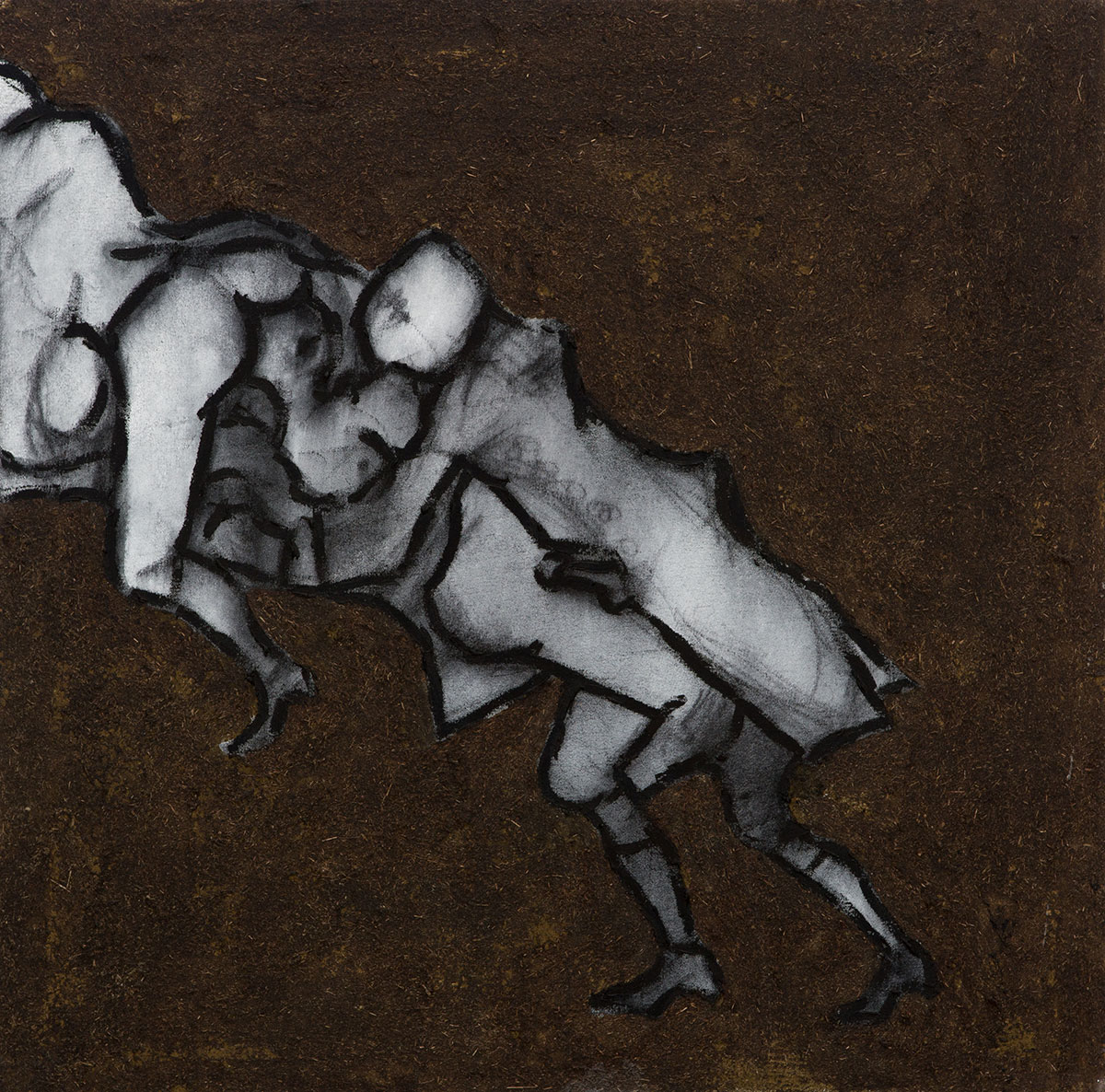
Trap I, 2015
Cow dung and oil on canvas · 70.5 × 70.5 cm
His first solo exhibition in Johannesburg, consisting of new paintings and sculptures, video work and a performance with musician Larissa Johnson. The exhibition saw the continuation of Ka Zenzile's use of cultural references to confront history, economic systems and political ideologies.
© Mawande Ka Zenzile. Courtesy Stevenson, Cape Town / Johannesburg / Amsterdam.
View full archive →Practice
Full Biography →From the sociopolitical body inward — past the figure, past representation.
My practice spans over two decades now — restless, sustained, never settled. I started with figurative, sociopolitical painting, putting the Black body in direct confrontation with the legacies of apartheid and colonial violence. But I moved inward. Not toward abstraction — I don't call it that. I call it non-figurative. That distinction matters. Abstraction, in the Western sense, dissolves the body into pure form, into the tonal's tidy categories — the known world, reasoned and resolved. Non-figurative refuses that. It insists on presence. It insists on knowing. The body, for me, is not a shape to resolve into decoration. It's a cosmological fact.
Cow dung sits at the centre of this. In isiXhosa healing tradition it's sacred material — used for centuries to purify homesteads, to connect the living to the ancestors. So when I use it, it's not symbol. It's substance. It's a direct conduit to the Amaxhosa worldview, and it's a refusal — a refusal of the Western art historical hierarchy that decides what counts as a legitimate medium. I put it on canvas, on hessian, on unprimed linen, and it carries the smell, the texture, the memory of a cosmology that was never broken. Only suppressed.
That suppression isn't incidental. It's epistemicide — the systematic invalidation of one knowledge system by another that has declared itself universal. That's the precise site my Archetypocalypse addresses. I coined the term myself. It's a conceptual and methodological framework for decolonising knowledge production in Fine Art and in higher education — diagnostic, restorative, rooted in praxis. It challenges the historicist, objectifying, positivist paradigms that still govern how art is taught, critiqued, legitimated in these institutions. I draw from African epistemology, decolonial theory, indigenous methodologies, practice-led inquiry. But Archetypocalypse isn't a provocation. It's a proposition: that the archive of isiXhosa spiritual and intellectual life is a rigorous, generative, irreducible knowledge system — as deserving of institutional and critical gravity as any Western theoretical canon.
The work — painting, bronze sculpture, neon, installation, performance — is the evidence.
Framework
Archetypocalypse
“Archetypocalypse is a term I coined to hold two things together: archetype — the inherited patterns that condition how we perceive and understand; and apocalypse, in its original Greek sense — revelation, the unveiling of what’s been concealed. So it’s not one or the other. It’s both at once: the pattern, and the unveiling of the pattern. I use it as a generative instrument — to open space for artistic, philosophical, and pedagogical practice grounded in African epistemologies.”
“My research starts from where I stand — as a professional artist and as itola/imboni. That position gives me access to indigenous ways of knowing, direct and intuitive, that the dominant culture doesn’t count as knowledge at all. Doesn’t even register it as existing. This isn’t metaphor. It’s method. Knowledge lives in the body. The unseen borders the seen, and that border is productive — it’s where the work actually happens. The studio isn’t a workshop. It’s where I do philosophy.”